Liesel Landauerová—Ottilie Landauer mother-daughter relationship
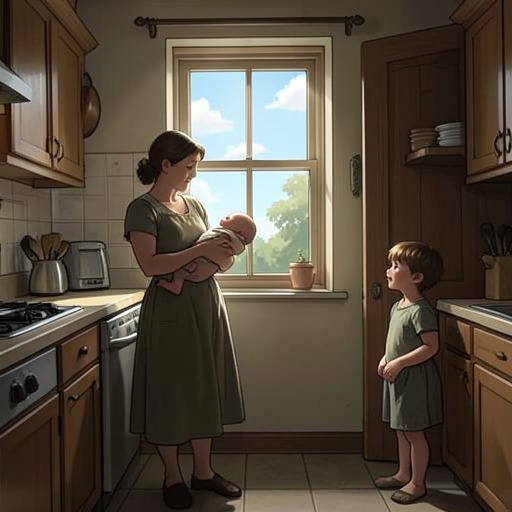
The Glass RoomLiesel Landauerová’s relationship with her daughter Ottilie is introduced before Ottilie is born and then grounded in the daily acts of caring for her. The child becomes part of the imagined future of the Landauer home: von Abt draws an infant on the terrace as he sketches the house, and Liesel later longs to bring her newborn there. As the building and the family take shape together, the novel makes motherhood both an intimate bond and part of the house’s promise of a shared life.
Before Ottilie’s birth
While presenting his design to Liesel and Viktor Landauer, von Abt sketches a child running along the terrace and identifies the imagined infant as their first child. Liesel has only recently learned she is pregnant and has shared the news with very few people. Her confirmation turns the architect’s drawing into more than a design flourish: a house still emerging on paper already contains a figure from the family’s future.
The child enters the design at the same time that the couple considers how the house will be arranged. Von Abt proposes separating the bedrooms from the servants’ quarters, with room for the motor cars between; the clean geometry of the sketch then becomes a vision of family life. The infant on the terrace gives that future a human scale. Ottilie is not yet born, but the expectation of her presence helps make the house a place intended for a growing family rather than merely an architectural statement.
Birth and first meetings
Ottilie is born in April while the house’s steel frame is rising. Liesel and Viktor choose a clinic and a modern method of delivery involving morphine and scopolamine; the latter removes Liesel’s memory of the event. The narrative therefore places the daughter’s arrival beside the house’s construction, but the two developments are experienced differently: the structure advances visibly, while Liesel’s own memory of childbirth is deliberately absent.
When Liesel speaks to von Abt after the birth, her account focuses on the baby’s small, distinct features. She describes Ottilie’s fingers and hands, miniature nails, and fingerprints, and admits that even when the infant looks at her, she cannot know exactly what the child sees. Ottilie’s frown leaves her mother feeling that she is being judged by standards she cannot identify. This uncertainty does not diminish Liesel’s delight; she says she feels exultant rather than depressed, and turns quickly from describing her daughter to asking how the house is progressing and how soon she can bring Ottilie there.
Motherhood at the building site
At the site, Liesel looks down at the unfinished steel frame and imagines the rooms, floors, furniture, and space already contained within it. Von Abt explains that he is resisting the workers’ preference for walls because he understands that Liesel wants space and light for her new child. His account links the house’s architectural openness directly to her maternal hopes. Liesel feels that he is realising a vision for her, Viktor, and their baby, and asks whether he will come to see Ottilie.
The visit makes the connection between mother and daughter concrete. When the baby wakes hungry, Liesel asks whether von Abt minds if she feeds her. She then asks him not to look away, making her wish for him to witness the act explicit. The scene is presented as an intimate moment of maternal care that also carries an awareness of his attention; Liesel wonders why his watching matters so much to her. That complication belongs to her encounter with von Abt, but the immediate focus remains the bond expressed through feeding and her desire to show him the child she has described.
Family life and the growing child
A later portrait of a day in the Landauer home shows Ottilie within a shared family routine. Liesel goes to see the children after getting dressed, while their nurse, Liba, supervises them. Martin is learning to button his shirt; Ottilie, who has recently learned to tie her shoelaces, sits on the floor demonstrating the skill to her younger brother. Her role has shifted from the infant whose features Liesel studied to a small child eager to pass on what she has learned.
The scene also places the mother-daughter relationship within the house’s ordinary rhythms. Ottilie and Martin dress under Liba’s care, while Liesel’s morning visit connects her to their daily lives. The house once existed as a drawing in which an imagined child ran across a terrace; now it contains children learning practical skills and sharing them with one another. Ottilie’s development gives that early image a domestic continuation, linking the home’s architectural ideal to the changing lives it shelters.
Significance
The relationship is built through a series of changes in scale: first an unborn child sketched into a proposed house, then a newborn known through her hands and feeding, and later a child teaching her brother. Each stage gives the future imagined by Liesel and von Abt a more ordinary and particular form. Motherhood is not described only as an abstract ideal; it appears in Liesel’s excitement, her attention to Ottilie’s features, her wish to bring her to the house, and the routines of family life.
The scenes also make the house and the relationship mutually defining. The home is designed with room, light, and space for a child, while Ottilie’s presence makes the promise of that design legible as a family’s future. Her birth occurs as the frame rises, and her later life unfolds among the domestic arrangements the house was meant to hold. The mother-daughter bond thus links the home’s conception to its use, carrying the imagined child on the terrace into the lived world of the family.